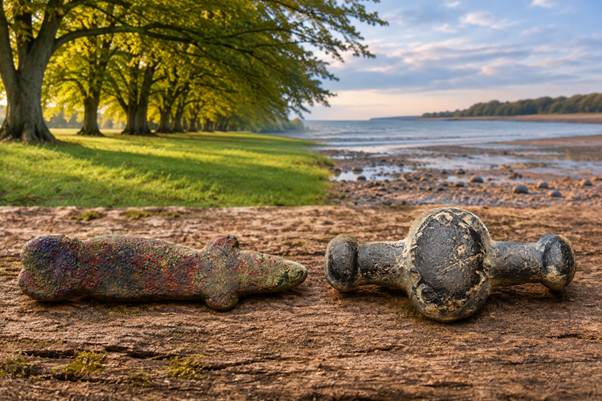
I once obtained permission to search a field alongside the suspected course of a Roman road. The first interesting find was a Tudor belt mount, dating from the post-medieval period. It was hardly what I had been looking for, but it encouraged me to continue searching.
As the investigation progressed, I found a couple of Iron Age copper-alloy coins but no Roman material whatsoever. Instead, an enormous quantity of medieval and post-medieval artefacts began to emerge. Clearly, the field had a history quite different from the one I had originally anticipated.
A possible explanation eventually came from an unexpected source. In the writings of a local historian, I discovered a reference to a landmark known as the Hundred Beech, associated with the meeting place of the local hundred.
Beech trees stood along two sides of the field, although there was no way of establishing whether any of them was the original Hundred Beech. Nevertheless, the historical reference, together with the abundance of medieval and post-medieval finds, suggested that I might have discovered the location of a medieval moot site.
I had started out investigating a possible Roman road, but the first interesting find had been a relatively modest Tudor belt mount. It certainly hadn’t identified the site’s earlier function, but it had given me a reason to persevere.
A Clue to a Lost Port
My second example also began with a belt mount, although this time I had a rather different objective.
I had been researching the possible location of an old port, and my investigations led me to a promising stretch of foreshore. I hoped that metal detecting might provide some physical evidence to support my research.
The first significant discovery was a medieval belt mount dating from approximately 1200–1400.
On its own, this was hardly proof of a port. Belt fittings could be lost almost anywhere people lived, worked or travelled. Nevertheless, the date was encouraging, and I continued searching.
My persistence was rewarded. Over time, a considerable number of Saxon and medieval finds emerged from the foreshore, demonstrating activity in the area over a substantial period.
The discoveries didn’t, by themselves, establish that I had located the port, but they provided useful supporting evidence for my research.
Once again, an apparently modest belt mount had been the first indication that the site deserved further attention.
Following the Evidence
These two experiences illustrate an important lesson I’ve learned over many years of detecting. We often begin searching a site with a particular theory in mind, but the finds don’t necessarily conform to our expectations.
In the first case, I was looking for evidence of a Roman road but discovered material suggesting a quite different history. In the second, the finds encouraged me to continue investigating a possible medieval port.
Neither belt mount was especially valuable or remarkable, yet both marked the beginning of much more interesting discoveries.
Perhaps the real skill lies not simply in finding objects, but in recognising their significance and being prepared to follow the evidence wherever it leads.
After all, the finds don’t know what we’re looking for — they have their own story to tell.
Continue Learning
If you enjoyed this article, you’ll find many more practical guides organised by topic on the Metal Detecting Guides & Tips page.
Whether you’re interested in research, permissions, field techniques, understanding finds or responsible detecting, it’s the best place to continue your journey.
👉 Browse Metal Detecting Guides & Tips
Recent Comments