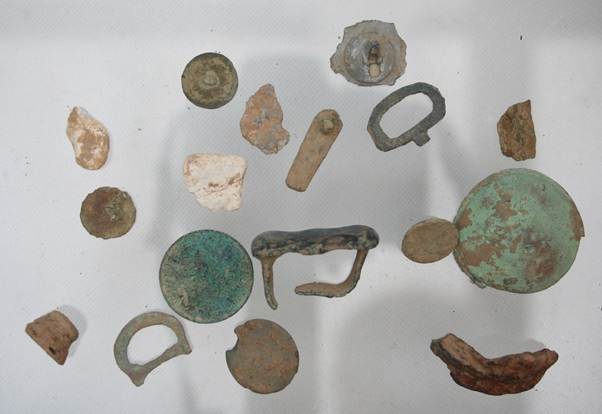
Take a look at the finds above. Not exactly a day’s detecting to set the pulse racing.
A few buttons, pieces of lead, a buckle, a worn coin and several objects that might take a little more investigation.
A disappointing collection?
Perhaps.
But if these were your finds from a new field, I’d be asking another question:
What are they telling me about the site?
We all like the signals that produce coins and recognisable artefacts. They’re the finds we photograph, show our friends and take home to identify. Nobody gets particularly excited about another scrap of lead or a broken piece of copper alloy.
But when I’m trying to understand a site, I’m interested in more than the best finds.
Sometimes even the rubbish is telling me something.
Not All Rubbish Is Equal
There’s rubbish and there’s rubbish.
Modern aluminium, ring pulls, foil and pieces of agricultural machinery may tell us very little beyond the fact that the field has been farmed and people have been there recently.
Older rubbish can be rather different.
A scatter of lead, broken buckles, buttons, worn copper coins and fragments of unidentified copper alloy may not look very impressive in the finds pouch, but once some of those objects can be dated, they may begin to reveal how long material has been accumulating on the land.
That doesn’t automatically make it a good detecting site.
It does, however, give me a reason to pay attention.
The important question isn’t simply:
Am I finding rubbish?
It’s: What sort of rubbish am I finding?
The Quiet Field
We’ve probably all experienced fields that seem almost completely silent.
You walk and walk with very few signals. When something finally does appear, it’s a modern object or an occasional piece of iron.
That doesn’t necessarily mean nobody was ever there, of course. Soil conditions, previous detecting, land use and many other factors can affect what we’re finding.
But compare that with a field where signals are regularly producing old buttons, bits of lead, buckles and worn coins.
Neither field has yet produced anything spectacular.
Which would you rather continue searching?
I know which one would hold my attention.
The second field is giving me evidence that things have been happening there.
The next job is to work out what.
Lead Deserves a Second Look
Lead is probably one of the best examples.
Detectorists recover enormous quantities of it. Much is impossible to date with any confidence and a shapeless lump of lead should never be turned into a medieval artefact simply because we’d like it to be one.
Nevertheless, I don’t ignore lead altogether.
Recognisable objects are obviously different. Spindle whorls, weights, seals and other identifiable pieces can sometimes contribute useful evidence.
Even apparently anonymous lead can make me curious when I’m finding a lot of it within a relatively restricted area.
Why is it there?
Is it simply agricultural debris? Has material been spread on the field? Is it associated with some activity that took place nearby?
I may not be able to answer the question immediately, but a concentration is worth noticing.
As with so much in detecting, context matters more than the individual object.
Broken Can Be Better Than Nothing
The same applies to incomplete finds.
A broken buckle isn’t going to compete with a hammered coin for attention, but if I can identify and broadly date it, it has given me information.
Find another buckle of a similar period and I’m more interested.
Add a contemporary strap fitting and perhaps a worn coin, and something begins to develop.
None of those finds proves that there was a settlement, market, fair or anything else on the site. We shouldn’t make the evidence say more than it does.
What they do demonstrate is activity.
And once I’ve established that, I have something worth investigating.
This is why I don’t judge a day’s detecting simply by the monetary or aesthetic value of what I’ve found.
Sometimes a broken object is more useful to me than a complete one from a period already well represented on the site.
Buttons Have Their Uses
Buttons are another good example.
We find so many that it’s easy to stop paying much attention to them. Some are relatively modern and tell us little. Others can be dated reasonably closely and may help establish when an area was being used.
A concentration of buttons can also raise questions.
Why are there so many here?
Were people working in this part of the field? Was there a path nearby? Are they simply part of the general scatter produced by centuries of cultivation and manuring?
Again, the button doesn’t give us the answer.
It gives us a question worth asking.
And if other finds begin supporting the same period or concentration, that question becomes more interesting.
Don’t Turn Rubbish into Evidence
There is a trap here.
Once we decide that insignificant finds can be useful, it’s very easy to go too far and start treating every scrap of metal as evidence for something.
It isn’t.
A field full of lead doesn’t automatically conceal an ancient settlement. A dozen buttons don’t prove that a footpath once crossed it. A broken buckle doesn’t mean there must be a medieval site nearby.
We still need evidence.
That may come from other finds, their distribution, old maps, documentary research or simply from repeated searching.
The ordinary finds are clues, not conclusions.
That distinction matters.
Look at Where You’re Finding It
One of the most useful things we can do is notice whether apparently insignificant finds are evenly scattered or concentrated.
If buttons, buckles, lead and older copper-alloy objects occur randomly across fifty acres, they may simply represent the normal background of material accumulated on farmland.
But suppose several begin appearing within one relatively small area.
Now I’m interested.
I want to know whether the concentration continues. I may change direction and search across it from another angle. I’ll pay more attention to the next few signals and make a mental note—or better still, a proper record—of where the more interesting objects are appearing.
Sometimes nothing develops.
At other times that apparently unpromising scatter leads to something much more significant.
You don’t know until you investigate it.
What Is the Field Telling You?
This is really what it comes down to.
A successful day’s detecting doesn’t always have to end with a spectacular find.
Sometimes I’ve learnt something about the field.
I’ve discovered that one area contains considerably more old material than another. I’ve found objects suggesting a particular period of activity. I’ve identified an area that deserves another visit—or perhaps discovered that my original theory about the site was wrong.
That information has value.
It can determine where I search next, what research I do when I get home and whether the site deserves more of my time.
The contents of the finds pouch may still look thoroughly unimpressive.
But that doesn’t mean the day has been wasted.
So next time you’ve been detecting for an hour and all you have to show for it is a handful of buttons, lead and broken bits of copper alloy, don’t ask only:
Have I found anything good?
Ask another question:
What are these finds telling me?
Because sometimes rubbish is simply rubbish.
But sometimes it’s the first indication that you’re searching in exactly the right place.
Recent Comments